
What recent investments reveal about the next phase of India’s semiconductor ecosystem
When we published our earlier article, “India’s Semiconductor Opportunity Is Bigger Than the Chip,” we asked whether India’s opportunity extended beyond fabs, packaging and chip design. Recent investments suggest that it does.
India is building manufacturing capacity through companies such as Tata Electronics, Micron, CG Power, Kaynes, Suchi Semicon and HCL-Foxconn. Meanwhile, Indian startups are developing semiconductor IP, power-management solutions and specialised technologies. But recent private-capital activity reveals another dimension: investors are beginning to fund the technologies that make better chips possible.
Consider three investments announced in August and September 2026.
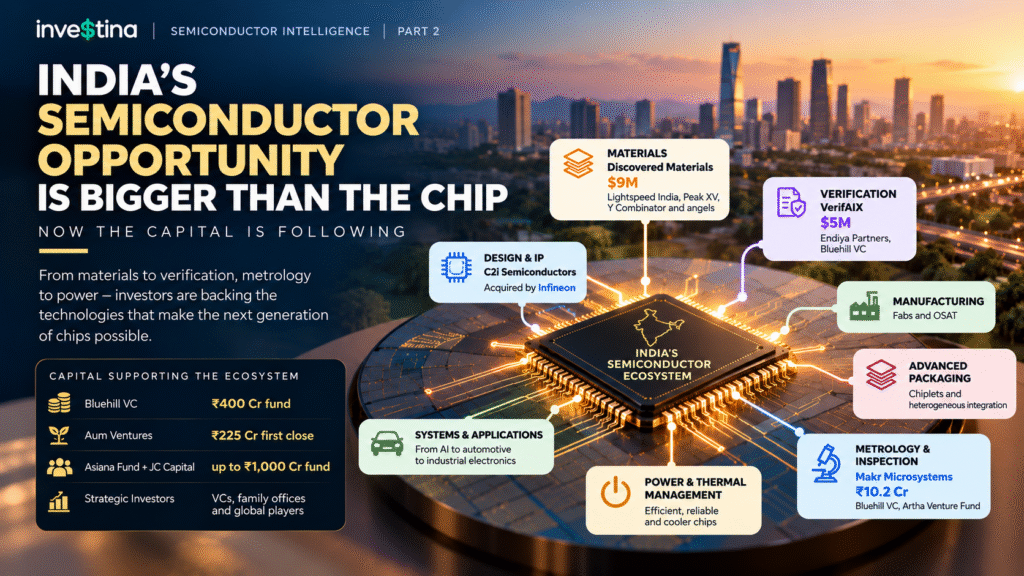
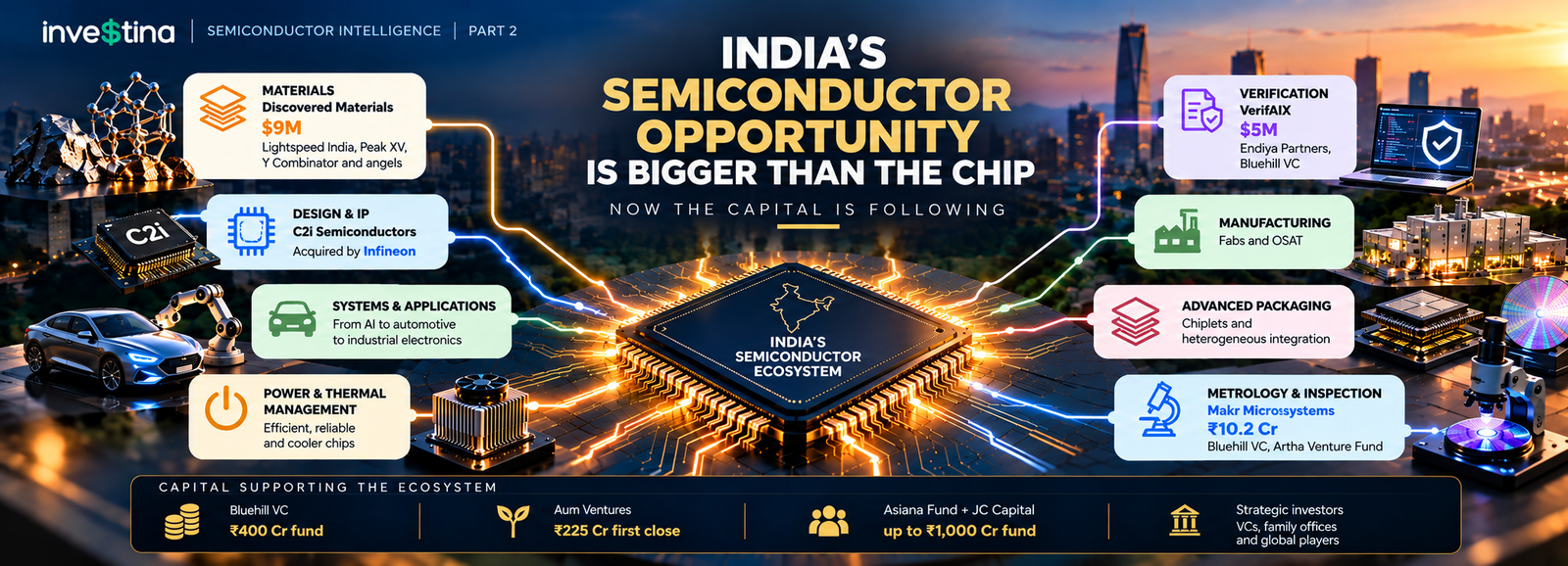
Discovered Materials raised $9 million in a seed round led by Lightspeed India, with participation from Peak XV, Y Combinator and technology angels. The IIT Madras-founded company uses AI to discover materials for semiconductor applications, initially addressing thermal-management challenges associated with increasingly powerful AI chips.
Makr Microsystems raised ₹10.2 crore from Bluehill VC and Artha Venture Fund. Its nanoscale metrology and inspection technology targets semiconductor manufacturing and advanced packaging, including hybrid bonding and chiplet interconnects.
VerifAIX raised $5 million, co-led by Endiya Partners and Bluehill VC, to develop AI-powered semiconductor verification. As AI increasingly assists chip design, verifying that designs meet their specifications becomes critical.
These companies are tackling different problems, but they share a common thread: their businesses sit around the chip rather than focusing solely on designing one.
Capital is becoming more specialised
The investor ecosystem is evolving alongside the technology.
Bluehill VC closed its maiden ₹400 crore frontier-tech fund in August, targeting sectors including semiconductors, defence, space and advanced manufacturing. Its investments in Makr Microsystems and VerifAIX demonstrate how specialised capital can translate into actual semiconductor-related investments.
Aum Ventures announced a ₹225 crore first close for its planned ₹750 crore India Innovation Fund II, which targets semiconductors, AI, space, defence, robotics and advanced manufacturing.
Meanwhile, Asiana Fund and JC Capital launched an advanced manufacturing and innovation fund targeting a corpus of up to ₹1,000 crore, with semiconductors, computing, materials, aerospace and defence among its focus areas.
These fund sizes represent capital being raised for future deployment, not money already invested in semiconductor startups. Nevertheless, they indicate that investors are building dedicated pools of capital for businesses with longer R&D cycles, complex engineering requirements and demanding commercialisation journeys.
Funding a chip is only the beginning
Indian semiconductor startups reportedly raised approximately $206 million across 51 rounds since 2022, including $61.9 million in H1 2026. The number of rounds has declined even as recent funding has become more concentrated.
This could indicate a more selective market, with investors placing greater emphasis on technical validation and commercial potential.
A successful architecture or tape-out is only one milestone. Startups must still validate silicon, qualify products with customers, resolve manufacturing and yield issues, and reach volume production. These stages can require substantial follow-on capital before meaningful commercial returns emerge.
India’s ability to bridge the gap between technical achievement and commercial scale will be critical to the next phase of its semiconductor ecosystem.
C2i shows why commercial outcomes matter
The acquisition of C2i Semiconductors by Infineon, completed on 5 October 2026, offers another perspective.
C2i had raised venture capital earlier in its journey, including a $15 million Series A led by Peak XV, followed by an extension taking the round to approximately $16.7 million. Its technology focuses on power-management solutions for high-performance computing and AI data centres.
The acquisition is significant because semiconductor ecosystems need more than funding announcements. Founders need pathways to build valuable businesses, investors need credible exits, and global semiconductor companies need reasons to acquire technology developed in India.
C2i illustrates how Indian engineering and semiconductor IP, supported by private capital, can become strategically relevant to a global company.
The role of government capital
India’s semiconductor programme has focused heavily on establishing manufacturing, packaging and testing infrastructure. The next challenge is helping technology companies finance the journey from technical validation to commercial scale.
Under the evolving Semicon 2.0 framework, the government has discussed co-investment mechanisms alongside private VC investors for qualifying semiconductor startups. If implemented effectively, such mechanisms could help address some of the financing risks associated with long development cycles.
The objective is not simply to establish semiconductor facilities in India, but to help Indian companies develop and commercialise valuable technologies within the global semiconductor value chain.
Where could the next opportunities emerge?
The recent investments point towards opportunities in semiconductor materials, AI-assisted EDA, verification, advanced packaging, chiplets, metrology, inspection, power delivery, thermal management and specialised equipment. Other opportunities may emerge in semiconductor cybersecurity and application-specific IP for automotive, industrial, defence and data-centre markets.
India does not need to dominate every layer. It can create substantial value by developing a smaller number of specialised, defensible technologies that global semiconductor companies depend on.
Some of these businesses may not even be widely recognised as semiconductor companies, despite supplying essential technologies to the industry.
Which parts of the semiconductor value chain will India own?
India has made progress in attracting manufacturing investment and building semiconductor capabilities. The next phase will depend on whether Indian companies can turn technical expertise into globally competitive products and businesses.
That requires founders who understand markets as well as engineering, investors willing to support longer development cycles, strategic partnerships, and customers prepared to adopt Indian technology.
The recent investments in Discovered Materials, VerifAIX and Makr Microsystems, the emergence of specialist funds such as those of Bluehill VC and Aum Ventures, and Infineon’s acquisition of C2i Semiconductors offer useful clues about where the ecosystem may be heading.
Our original question remains relevant, but the next one is more specific:
Which critical technologies surrounding the chip will Indian companies develop, commercialise and ultimately own?
The answer could define India’s next chapter in semiconductors and create opportunities well beyond chip manufacturing itself.
Sources: TechCrunch | Moneycontrol | VerifAIX | Business Standard | Your Story