
Not too long ago, If you wanted a rudraksha, you asked your grandmother where to buy one. If your family planned a puja, someone visited the temple personally, spoke to the priest, and arranged everything offline. If you needed guidance, it usually came from an astrologer your family had trusted for decades.
There were no apps. No push notifications reminding you about Ekadashi. No online priest bookings. No livestream darshan. And definitely no venture capital firms trying to understand devotional retention metrics.
But something changed. Not in faith itself, but in how faith began interacting with modern life.
As India became more digital, spirituality quietly adapted alongside it. People didn’t stop believing. They just started searching differently. Somewhere between “online puja booking,” “best rudraksha bracelet,” and “talk to astrologer now,” an entirely new ecosystem started taking shape.
At first, most people dismissed it as niche internet behavior. But what looked like a small category slowly started revealing itself as something much larger: a massive behavioral economy hiding in plain sight.
When Faith Got Login Screen
The earliest wave of startups focused on something deceptively simple: access.
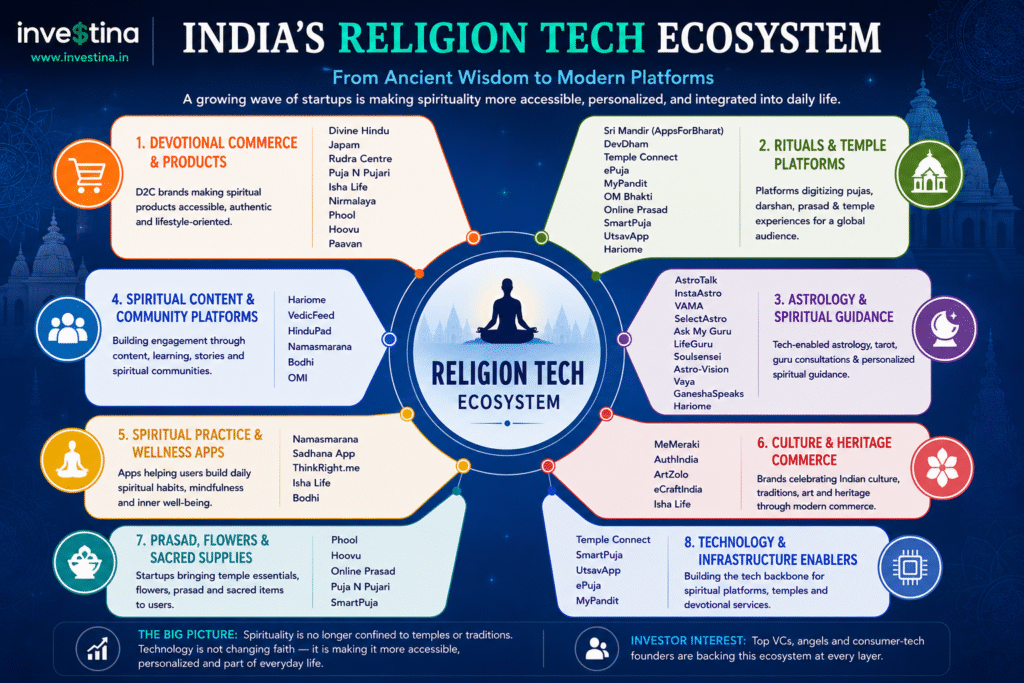
Companies like Divine Hindu, Japam, Rudra Centre, Puja N Pujari, Isha Life, Nirmalaya, Phool, and Hoovu, realised that spirituality already had something most startups spend crores trying to build:trust.
People were already buying malas, idols, incense, gemstones, rudrakshas, puja kits, devotional jewellery, temple flowers, spiritual wearables, and wellness products. The challenge wasn’t demand. It was convenience, authenticity, and distribution.
That realization changed the game. Suddenly, devotional products started behaving like premium D2C brands. Japam transformed spiritual accessories into modern lifestyle wearables. Divine Hindu blended traditional symbolism with contemporary branding. Nirmalaya and Phool turned temple flowers into sustainable incense and wellness products. Isha Life extended spirituality into food, clothing, home products, and conscious living.
And unlike traditional e-commerce purchases driven by discounts or impulse, these transactions were emotionally anchored. They were connected to rituals, family traditions, festivals, identity, and belief systems.
That kind of consumer behavior is incredibly hard to manufacture artificially, which is exactly why investors like BeyondSeed, Artha Venture Fund, Huddle Ventures, Shiprocket, Draper Richards Kaplan Foundation, Xpanse Services, D2C Insider Super Angels, and even consumer founders like Varun Alagh began entering the category.
Then the Temples Went Digital
The next wave of founders looked beyond products and focused on the rituals themselves.
Platforms like Sri Mandir (AppsForBharat), DevDham, Temple Connect, ePuja, OM Bhakti, Online Prasad, SmartPuja, UtsavApp, and Hariome, began building infrastructure around devotion itself.
What once required physical presence suddenly became digitally accessible. Pujas could now be booked online, darshans could be livestreamed, prasad could arrive at your doorstep, priests could be connected remotely, and temples that once served only local communities suddenly became globally accessible to Indians living thousands of miles away. For millions of Indians abroad, this wasn’t simply convenience. It was emotional continuity.
That emotional continuity became the foundation of one of the fastest-growing layers in Religion-tech. Sri Mandir alone now serves millions of users globally, while platforms like DevDham, OM Bhakti, and UtsavApp continue building devotional infrastructure around rituals and access.
And investors noticed quickly. Peak XV, Elevation Capital, Fundamentum, Mirae Asset, Titan Capital, All In Capital, WEH Ventures, TDV Partners, and SIG Venture Capital all began taking positions across this layer.
Because unlike most consumer tech startups trying to manufacture engagement, these platforms were organizing behaviors that already existed for centuries. Technology didn’t create the ritual. It simply created scalable access around it.
The Most Profitable Layer Was Never Products, It Was Guidance
Then came the layer that completely changed investor perception of the category. Guidance.
Companies like AstroTalk, InstaAstro, VAMA, Ask My Guru, LifeGuru, Soulsensei, Astro-Vision, Vaya, GaneshaSpeaks, and Hariome, realized something deeply human:
People don’t just pay for products. They pay for reassurance. For timing. For clarity. For confidence. For hope. Astrology didn’t suddenly become popular because of technology. It became scalable because of technology.
And unlike commerce businesses, astrology-tech operates with almost no inventory, warehousing, or logistics complexity. The entire business is driven by engagement and repeat behavior.
That’s why companies like AstroTalk have reportedly scaled into hundreds of crores in annual revenue while attracting investors like Left Lane Capital. Meanwhile, InstaAstro, VAMA, and SelectAstro have drawn interest from Blume Ventures, Artha Venture Fund, QED Innovation Labs, PointOne Capital, BharatMatrimony, Accel, Arkam Ventures, Weekend Fund and several angel syndicates.
For investors, this was a major realization. Spirituality wasn’t just commerce anymore. It was recurring engagement with extremely high emotional retention.
The Quiet Layer Holding the Entire Ecosystem Together
Before users transact, they engage. And that’s where platforms like VedicFeed, HinduPad, Hariome, Bodhi, and OMI quietly became one of the most important parts of the market.
At first glance, they look like content platforms. But look closer. They are trust builders, engagement engines, retention systems, and behavioral infrastructure.
Through daily reminders, festival explainers, scripture content, spiritual storytelling, chanting ecosystems, and community engagement, these platforms quietly keep users emotionally connected to the ecosystem every single day.
Some of them are interesting because they dont sit in one category. They span across devotional content, rituals, astrology, spiritual guidance, and services, making it structurally closer to a spiritual super platform than a simple content website.
Meanwhile, others represent another fascinating shift entirely, spirituality becoming habit driven. Chanting, remembrance, mantra repetition, and devotional practice are no longer occasional acts. They’re becoming measurable digital engagement loops.
And that changes everything. Because once spirituality becomes habit driven, the ecosystem stops behaving like seasonal devotion and starts behaving like a modern retention platform.
The Habit Economy Nobody Expected
This is where the category becomes especially fascinating from an investor perspective.
If commerce creates transactions, and astrology creates monetization, then habit apps create retention. Platforms like Namasmarana, Sadhana App, ThinkRight.me, Isha Life, Bodhi, and newer guided spiritual ecosystems are no longer asking users what they want to buy. They’re asking:
“How often do you want to connect?”
That subtle shift changes the entire structure of the business.
Because once spirituality becomes daily, personalized, measurable, trackable, and community driven, it begins behaving less like a ritual and more like a consumer engagement ecosystem.
Even AI is now entering the category. Platforms are experimenting with personalized astrology, AI generated spiritual guidance, multilingual chanting support, devotional recommendations, and intelligent priest matching.
What looked ancient from the outside is quietly becoming technologically layered underneath.
Beyond Religion: The Rise of Identity & Culture Commerce
Perhaps the most surprising evolution is happening just outside the religion tech core.
Companies like MeMeraki, AuthIndia, ArtZolo, eCraftIndia, and lifestyle ecosystems like Isha Life, are no longer selling religion directly.
They’re selling culture, aesthetics, heritage, mindfulness, and belonging. This is where India’s spiritual economy starts blending with wellness, conscious living, premium gifting, home decor, and cultural identity.
And this layer may ultimately become one of the largest opportunities of all, especially among younger consumers and the global Indian diaspora looking to stay connected to culture in more modern ways.
Why Investors Are Taking This Seriously
The biggest reason investors are entering this category is surprisingly simple. The behavior already exists. People were already praying, chanting, buying devotional products, consulting astrologers, consuming spiritual content, participating in rituals, and seeking emotional reassurance.
Technology didn’t create the behavior. It organized it. That distinction is incredibly important.
Because the strongest businesses are rarely built by forcing new behavior into the market. They’re built by understanding existing human behavior deeply enough to scale it efficiently.
And now the investor movement is becoming visible. Peak XV, Elevation Capital, Blume Ventures, Titan Capital, Artha Venture Fund, All In Capital, Fundamentum, Left Lane Capital, WEH Ventures, QED Innovation Labs, and several consumer-focused angels have already entered various layers of this ecosystem. Even founders and public figures like Alia Bhatt, Varun Alagh, Harit Nagpal, and Kunal Bahl have started backing companies in the space.
That’s no longer experimentation. That’s pattern recognition. India’s spiritual economy sits precisely at an intersection. This isn’t simply religion becoming digital. It’s commerce becoming emotional, rituals becoming infrastructure, guidance becoming scalable, content becoming habitual, and culture becoming investable.
And the most interesting part? We’re probably still early.
Because spirituality is no longer something people engage with occasionally. It’s becoming a daily, digital, personalized, and behavior driven ecosystem layered across commerce, content, services, identity, and technology.
Not as a temporary trend. But as a modern interface built around one of humanity’s oldest behaviors.